AI FOR COMPARATIVE ONCOLOGY

Cancer doesn't care
about species.
Neither should
cancer research.

We use AI and open biological data to search cancer across dogs, cats and humans for connections that might otherwise be missed.

01 Real data 02 Cross-species insights 03 Evidence first
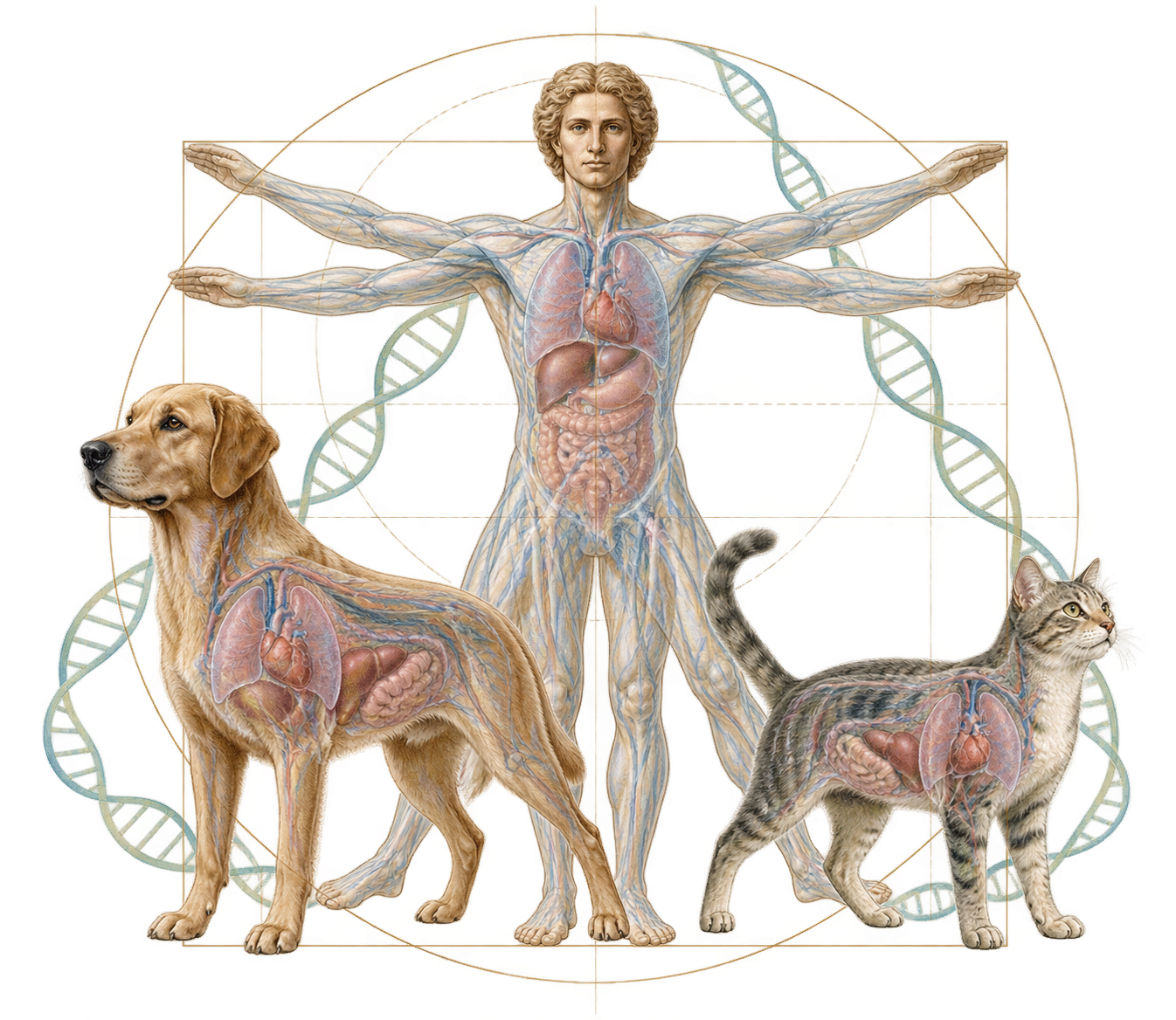
Scientific illustration showing shared anatomy and biology across a human, dog and cat

Different species.
Shared biology.
More clues.

WHY THIS MATTERS

One disease. Three species. Millions of clues.

Cancer affects all of us. Looking across species can reveal patterns that are harder to see when we study people, dogs and cats separately.

Human portrait representing people in comparative oncology

HUMANS

~39%

Around four in ten people in the US will be diagnosed with cancer during their lifetime.

Some of the most common cancers

  • Breast cancer (breast tissue)
  • Lung cancer (lungs)
  • Colorectal cancer (colon or rectum)

Rates and rankings vary by country, age and sex. Source: US National Cancer Institute ↗

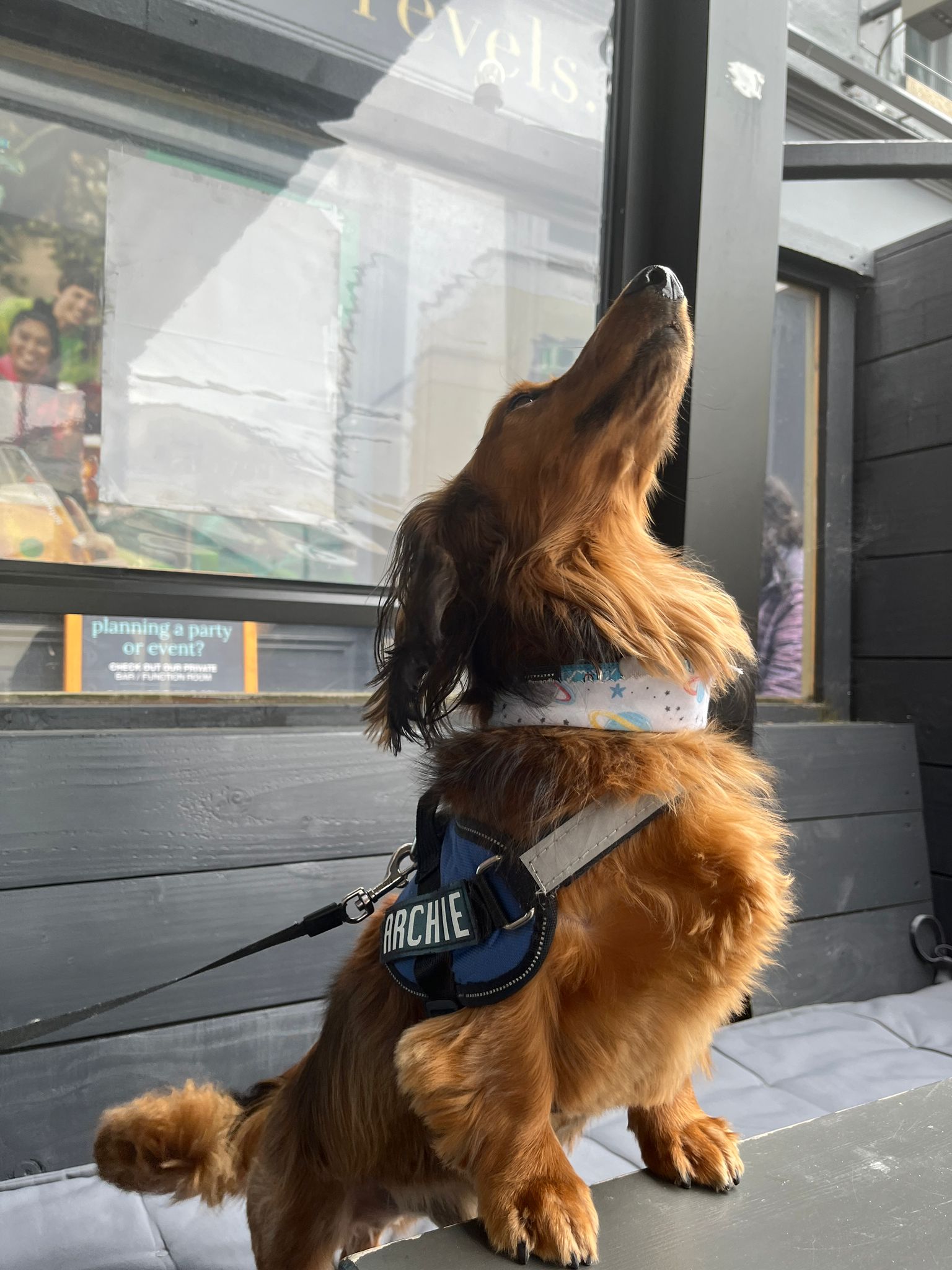
Archie, a long-haired dachshund

DOGS

~25–33%

Cancer is common in dogs, particularly as they get older. Around half of dogs over ten are affected by cancer.

Important canine cancers

  • Lymphoma (lymphatic and immune system)
  • Osteosarcoma (bones)
  • Hemangiosarcoma (blood-vessel cells, often affecting the spleen or heart)

Source: AAHA Oncology Guidelines ↗

Tabby cat representing cats in comparative oncology

CATS

We don't know
well enough.

Cancer is common in older cats, but high-quality population data are still surprisingly limited.

Important feline cancers

  • Lymphoma (lymphatic and immune system)
  • Mammary carcinoma (mammary or breast glands)
  • Squamous cell carcinoma (skin and lining tissues, often the mouth, nose or ears)

Feline population-level cancer data remain less complete than human and canine data.

CANCER, IN PLAIN ENGLISH

Same enemy. Different species.

A human, a dog and a cat are obviously different. But cancer exploits some remarkably similar pieces of biology in all three.

01

What is cancer?

Your body is made of cells. Normally they grow, divide and die under tight control. Cancer begins when cells escape those controls and keep growing when they shouldn't.

02

Why compare species?

Dogs, cats and people naturally develop cancer. Some tumours use related genes and biological pathways, giving researchers three different views of the same underlying problem.

03

Why does AI help?

The evidence is spread across huge numbers of datasets, papers and experiments. AI can help connect those pieces and highlight patterns a researcher might not encounter in their own field.

WHAT CANCER CAN SHARE

DNA damage Uncontrolled growth Immune escape Tumour evolution Metastasis Treatment resistance

WHAT CAN DIFFER

Which cancers are common Inherited risk Drug metabolism Lifespan Immune biology Amount of research data

That's the opportunity: look for what is shared, understand what is different, and find the experiment the existing evidence suggests should come next.

COMPARATIVE ONCOLOGY, IN PLAIN ENGLISH

What if a clue found in one species could help another?

Dogs, cats and people naturally develop many of the same cancers. The diseases aren't identical, but they can involve related genes, biological pathways and responses to treatment.

Comparative oncology studies those similarities and differences. Archie adds AI to help connect evidence scattered across thousands of datasets and research papers.

THE METHOD

What Archie actually does.

From data to discovery, with evidence at every step.

01

Read

Bring together cancer datasets and research from different species.

02

Connect

Look for genes, pathways and treatments that appear across species.

03

Question

Search for something particularly valuable: the experiment nobody appears to have tried yet.

04

Verify

Nothing becomes a finding because AI said it. Every claim must link back to evidence and survive validation.

INSIDE ARCHIE

Follow the evidence across species.

RESEARCH RECORD

Archie doesn't simply ask an AI for cancer ideas. It starts with biological data, tests what changes, connects equivalent biology across species and keeps a record of every step.

01 Cancer data Real experimental datasets
→
02 Genes What changes in disease?
→
03 Species map Dog · Cat · Human
→
04 Pathways Which systems are affected?
→
05 Evidence Papers · datasets · trials
→
06 Missing experiment What hasn't been tried?

ARCHIE-000C · BLIND VALIDATION

32/105

published biological terms independently recovered from the underlying canine lymphoma data.

38.6× random overlap expectation
WHAT ARCHIE REDISCOVERED ARCHIE ↔ PUBLISHED SCIENCE
Cell cycle MATCH
DNA replication MATCH
DNA repair MATCH
T-cell activation MATCH
Lymphocyte activation MATCH

Archie's result was cryptographically frozen before the published benchmark was introduced into the analysis environment.

CROSS-SPECIES BIOLOGY

Different bodies. Related molecular machinery.

Archie maps equivalent genes between species and asks whether cancer is disrupting related biological systems.

HUMAN
DOG
CAT
SHARED SIGNALS BCL6 LCK CD38 FGFR2

THE EVIDENCE GRAPH

See cancer biology as a network, not a filing cabinet.

Archie connects species, genes, biological pathways, datasets and published evidence. The goal is to make the gaps visible too.

Species Gene Biology Evidence
SELECT A NODE Explore the evidence.
ARCHIE-001 · RESEARCH ACTIVE

THE RESEARCH QUESTION

Not another fact we already know.

A connection we missed.

DOG T-cell lymphoma
+
CAT T-cell lymphoma
+
HUMAN T-cell lymphoma
FIND THE MISSING EXPERIMENT →

MEET ARCHIE SCOUT

Finding a paper is easy.
Knowing what to trust is harder.

SCOUT SEARCH RECORD

Archie Scout searches scientific databases for potentially useful cancer evidence. It can read at a scale no individual researcher reasonably can. But nothing Scout finds automatically becomes a fact.

FIRST MISSION · COMPLETE

Feline T-cell lymphoma

What reusable molecular datasets and primary research are available for T-cell lymphoma in cats?

11 searches PubMed 19 Sept 2026
251 papers discovered
↓
48 need deeper evidence checks
138 useful context
65 rejected in first-pass verification
↓
0 automatically published as validated evidence
✓

Scout cannot publish its own discoveries.

New evidence goes into quarantine first. Archie checks what the research actually says, preserves its provenance and tests the verification system itself. Only evidence that clears the appropriate checks can enter the public Knowledge Graph.

VERIFIER v0.2 · CONTROLLED EVALUATION

10 / 10

Five relevant papers retained. Five deliberately irrelevant controls rejected. The test was repeated after the first version scored 9/10. No evidence was promoted automatically.

MISSION ARCHIVE · SEPTEMBER 2026

Cannabinoids and cancer across species

Six research memos are now available alongside the papers and citation corrections.

Read the research note →

OPEN RESEARCH

Human-readable.
Machine-readable.

Archie doesn't hide its work. Every completed research mission is designed to be understandable by people and interrogable by machines.

FOR HUMANSUnderstand the research.

Browse the research questions, disagreements, original memos and source papers. Open the catalogue →

FOR MACHINESInterrogate the evidence.

Read the investigation records, evidence status and original memo texts. Open the JSON catalogue →

No black box. No “AI says so.” Follow the evidence.

Cancer research is too important for useful knowledge to remain trapped in papers, databases, institutions or AI conversations.

ARCHIE RESEARCH LAB

Archie isn't one AI.
It's a research team.

One AI searches. Another verifies. Another compares cancer across species. Another looks for experiments nobody appears to have done. Then another tries to prove them all wrong.

01Chief Scientist

What question should we answer?

02Scout

What evidence exists?

03Verifier

What does it actually say?

04Cross-Species Analyst

What biology is shared?

05Gap Finder

What's missing?

06Sceptic

Can we prove the finding wrong?

07Experiment Designer

What's the smallest useful experiment?

08Translator

Can a normal person understand it?

The agents are allowed to disagree.They're not allowed to invent evidence.
ARCHIE SEARCH RECORD 001PROVISIONAL SEARCH GAP

A MISSING EXPERIMENT?

Cannabinoids have been studied against cancer in humans and dogs.What about cats?

Archie checked whether its September PubMed search could identify a feline intervention study. The result describes that search and its limits.

HUMAN
Extensive

A substantial cannabinoid and cancer research landscape exists, from laboratory biology to early clinical research.

DOG
Direct evidence

Archie located experimental cannabinoid research in canine cancer, including lymphoma studies and work involving dogs receiving chemotherapy.

CAT
?

Archie has not yet located a direct published feline cannabinoid-cancer intervention experiment.

32targeted searches
→
2candidate papers
→
0direct experiments located

Archie tried to prove itself wrong.

Scout ran targeted PubMed searches covering feline lymphoma, mammary carcinoma, squamous-cell carcinoma, sarcoma and other feline cancers against CBD, THC, cannabinoid receptors and the endocannabinoid system.

Only two candidate papers were returned. Neither represented the missing feline cannabinoid-cancer intervention experiment.

What this does not mean.

Archie is not claiming that cannabinoids cure cancer, or that nobody has ever performed such an experiment. It means Archie has not yet located a published experiment answering this particular question. Dataset and registry searches are still required.

THE QUESTION

What happens when feline cancer cells are exposed to carefully controlled cannabinoids such as CBD or THC?

THE BIOLOGY BEHIND THE QUESTION

Your body already makes cannabinoids.

Humans, dogs and cats have an endocannabinoid system: a biological signalling network that existed long before anyone discovered cannabis.

MADE BY THE BODYEndocannabinoids
↓
YOUR BUILT-IN SIGNALLING NETWORKEndocannabinoid System
↑
MADE BY CANNABISPhytocannabinoids

Our bodies naturally produce signalling molecules including and . Cannabis produces different molecules, including and , that can influence parts of this existing biological machinery.

That does not mean cannabis cures cancer. It means there is real biology worth investigating.

ARCHIE'S PLAIN-ENGLISH DICTIONARY

No biology degree required.

Cancer research is full of intimidating language. Archie translates the terminology without removing the science.

OPEN RESEARCH

The Research Ledger

A transparent record of what worked, what didn't and what we're investigating now.

VALIDATED ARCHIE-000

Can Archie reproduce cancer biology scientists have already discovered?

Before asking Archie to find something new, we made it prove that its methods could recover biology already established by researchers.

000A · FAILED 000B · FAILED 000C · PASSED
32 / 105 published biological terms independently recovered
38.6× the random overlap expectation in our specified comparison

The successful result was cryptographically frozen before the published benchmark was introduced. Statistical interpretation accounts for important limitations including the hierarchical, correlated nature of Gene Ontology terms.

See the full story →
NOW INVESTIGATING ARCHIE-001

What can dogs, cats and humans teach each other about lymphoma?

This investigation compares molecular evidence across canine, feline and human T-cell lymphoma to search for shared vulnerabilities and overlooked treatment opportunities.

THE QUESTION

Has one species already given us a cancer clue that researchers in another species haven't fully explored?

Opened September 2026

ARCHIE-000

Why we publish the failures too.

A

Gene intersection

Failed.

Our first method found plausible cancer signals but failed its predefined validation test. We kept the result.

B

Pathway convergence

Failed.

The second method found shared lymphoma biology but still failed the benchmark we had set. We kept that result too.

C

Blind replication

Passed.

We redesigned the benchmark fairly, froze Archie's answer first, then revealed the published result. The overlap was substantial.

Science is not a slot machine where you keep pulling the handle until you get the answer you wanted. ARCHIE-000 exists to make that principle part of the software.
PROJECT UPDATES

Latest research

Follow the published work from the corrected note back to the underlying records.

23 SEPTEMBER 2026

A search for feline evidence

Scout ran 32 PubMed searches, returned two candidates and identified an unanswered question in that material.

Archie, the long-haired dachshund who inspired The Archie Project, wearing his Archie harness

THE DOG BEHIND THE NAME

Meet Archie.

Archie was a long-haired dachshund who died from lymphoma in September 2026.

His loss started a simple question: what if cancer research in dogs, cats and humans could learn more from each other?

The Archie Project is our attempt to find out.

A little dog. A big question.

OUR RULE

AI can suggest. Evidence decides.

Archie is a research project, not a medical service. Its findings are hypotheses and research evidence, not medical or veterinary advice.